
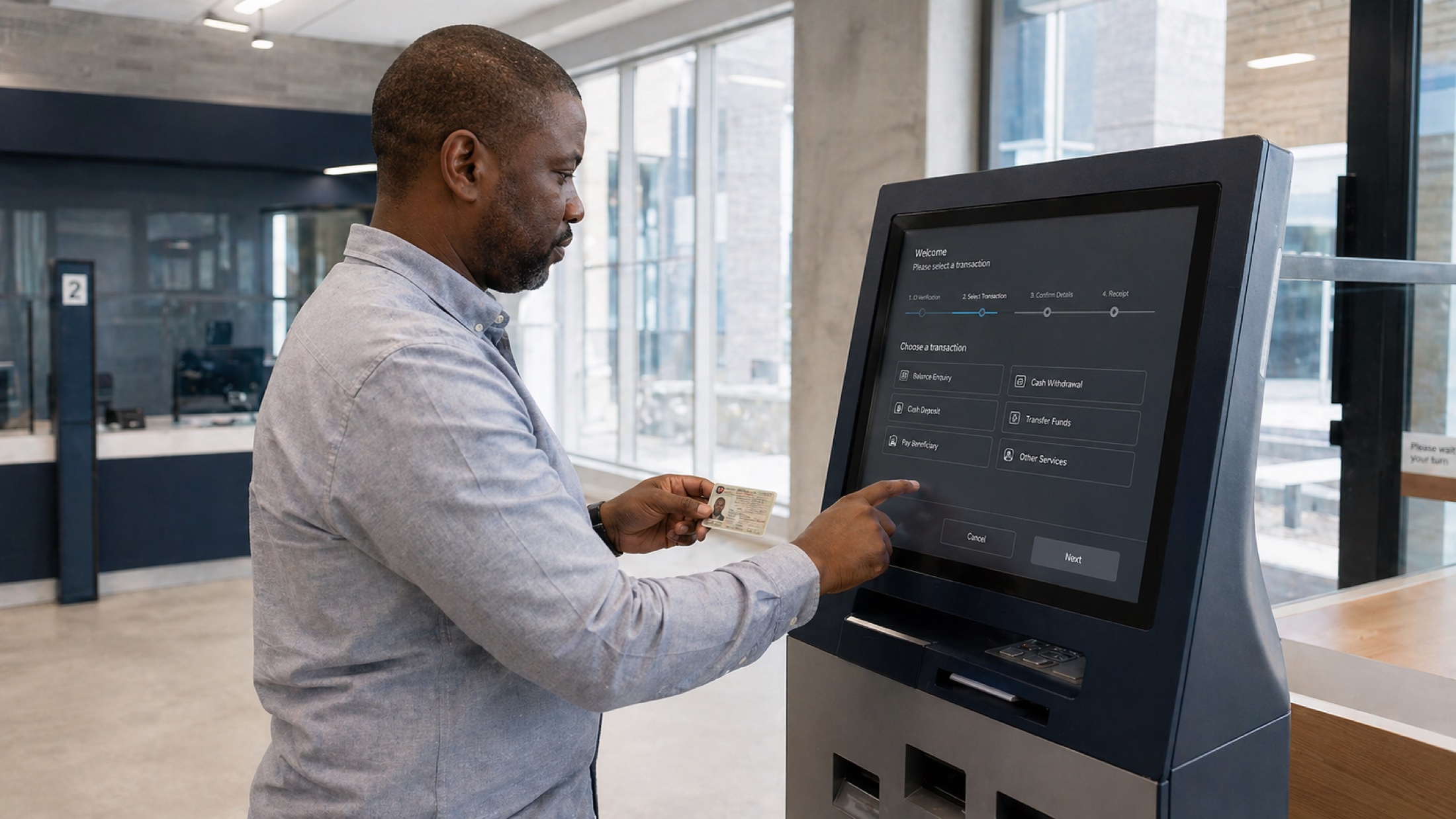
deployment · self-service terminals
Unattended terminals, running long sessions across critical journeys.
SSTs operate without a teller — minutes-long sessions across payments, account opening, and national-identity workflows. The evidence layer makes the device's role in those flows reconstructable to the bank, the regulator, and the identity authority.
Five things that are visible only because the kiosk signs them.
- ·01
Long-session execution
Multi-step kiosk flows — payment, account opening, ID verification — signed and hash-linked from first touch to last.
- ·02
Smart-ID adjacency
Citizen-identity workflows produce audit-grade integrity verifiable independently by operator, regulator, and identity authority.
- ·03
Physical-access boundary
Tampering, environmental manipulation, and prolonged proximity surface as signed deviations at the next event.
- ·04
Branch-fleet coherence
Thousands of terminals across dispersed branches produce the same evidence format, same verification path, same trust-basis declarations.
- ·05
Multi-step attribution
Each step in a citizen journey attributable to the device that executed it. Audit moves from narrative to deterministic lookup.
SST estates lean hardest on Operations and Integrity.
-
Forensics & proactive operations
On-demand ledger retrieval, predictive patterns, watermark capture
See the journey → -
Execution and key integrity
Per-device attribution, classified rejection reasons
See the journey → -
Approval-rate & customer experience
Long-session continuity, dispute resolution
See the journey → -
Payments in constrained networks
Cohort outage detection, reconciliation alignment
See the journey →